
The Last 10 Meters: Why “Fiber-to-the-Home” is Becoming “Fiber-to-the-Room”
For years, the telecommunications industry has measured success by the arrival of high-speed glass at the building’s perimeter. Fiber-to-the-Home (FTTH) was the gold standard promising a future of limitless bandwidth. However, a sobering reality has emerged: the “Last 10 Meters”. The span between the entry point and the end-user device has become the primary bottleneck for the modern digital enterprise.
The Gigabit Promise: A Slow Collapse
The gap between “Provisioning Speed” and “Delivered Experience” is widening. While ISPs are delivering multi-gigabit speeds to the doorstep, the internal distribution via legacy copper Wi-Fi often results in a 60-80% degradation of throughput by the time the signal reaches a home office.
In a corporate landscape defined by video conferencing and real-time cloud collaboration, this “best effort” internal networking is no longer commercially viable.
Technical Deployment: The FTTR Architecture
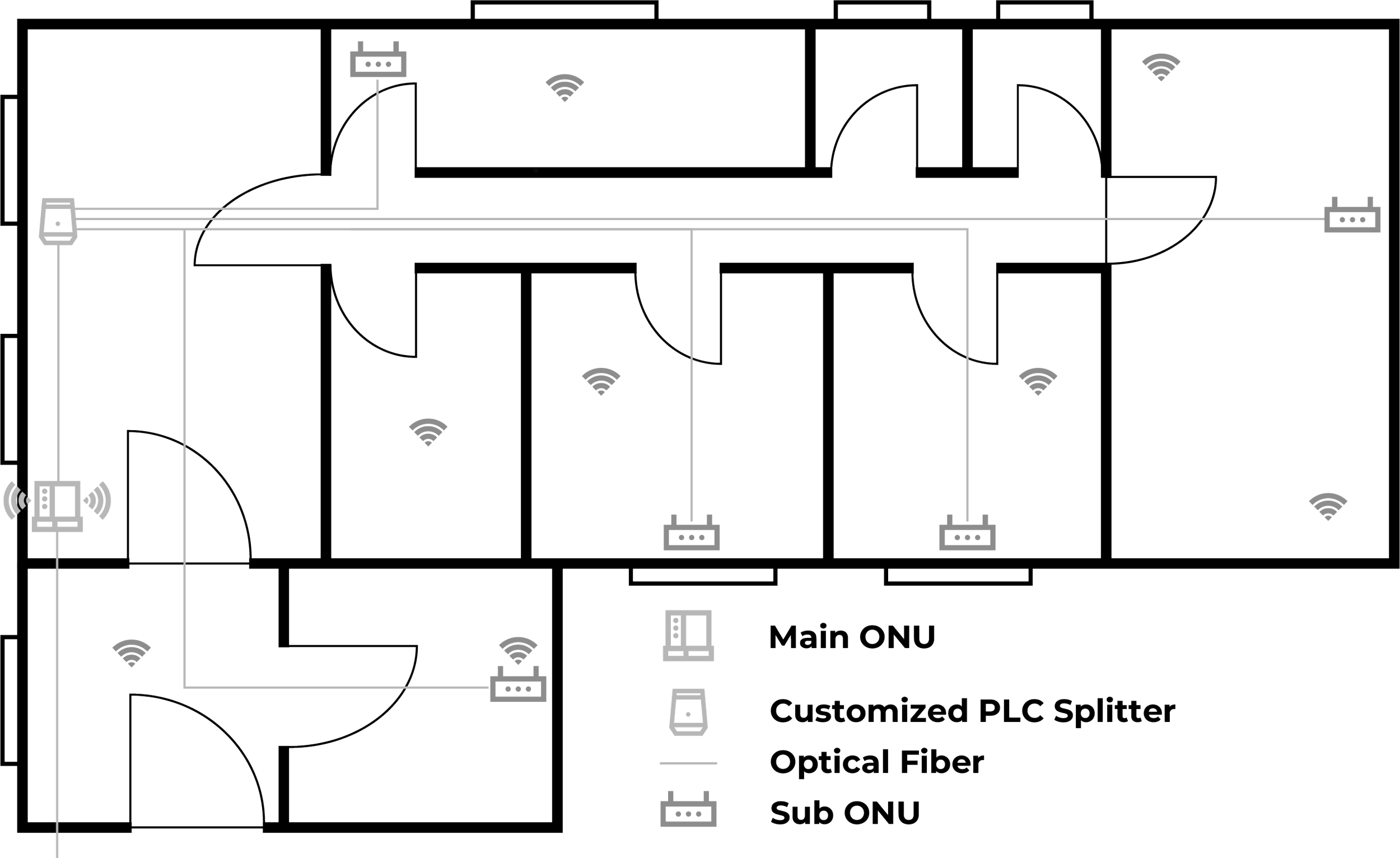
Transitioning to FTTR means replacing the idea of one central router with a fiber network inside the home, connecting each room directly instead of relying on a single Wi-Fi signal:
The Main Gateway (P-OLT): Replacing the standard ONT/Router combo, the Primary Gateway acts as a mini-Optical Line Terminal. It manages the external GPON/XGS-PON signal and intelligently routes traffic across the internal optical fabric.
Transparent Fiber Backhaul: The deployment utilizes G.657.B3 bend-insensitive fiber. With a bend radius as small as 5mm, these nearly invisible cables can be routed along baseboards and door frames with minimal effort. While attenuation and interference are rarely limiting factors in residential setups, the key advantage lies in flexibility: fiber can be installed exactly where access points are needed, without the placement constraints often associated with traditional cabling.
Secondary Edge Nodes (Sub-ONTs): Rather than using wireless repeaters, which halve bandwidth with every "hop", FTTR utilizes hard-wired optical nodes in each room. This ensures that the Wi-Fi 7 access point in the office has a dedicated 10Gbps optical backplane, providing "zero-distance" connectivity to the core network.
Strategic Advantages: Deterministic Performance
The technical shift to FTTR offers three distinct enterprise advantages:
Elimination of Electromagnetic Interference (EMI): Although rarely an issue in typical homes, fiber is inherently immune to electrical interference, an advantage that becomes critical in high-interference environments and adds an extra layer of stability for demanding use cases.
Symmetric Multi-Gigabit Throughput: FTTR supports the symmetric 2.5Gbps to 10Gbps speeds required for modern uplink-heavy tasks like high-definition 1:1 telepresence and large-scale cloud synchronization.
Future-Proof Scalability: The optical medium itself is media-agnostic. While Wi-Fi standards change every few years, the fiber infrastructure currently being deployed for FTTR is theoretically capable of supporting speeds up to 50Gbps or more with a simple transceiver swap at the endpoints.
From Connectivity to “Guaranteed Experience”
For stakeholders and service providers, FTTR is a pivot from selling a commodity (bandwidth) to delivering a premium service (omnipresent reliability). It allows for the implementation of Service Level Agreements (SLAs) within the residential environment, ensuring that the “Last 10 Meters” are as robust as the transoceanic cables that carry the data.
The Bottom Line
As we move toward an era of ever-present AI, 8K virtualization, and edge computing, the boundary of the network must move closer to the user. Fiber-to-the-Home brought us to the door; Fiber-to-the-Room brings us to the desk. The “Last 10 Meters” is no longer a gap to be bridged; it is the new frontier of high-performance networking.